
Adobe Certification Salary in NZ: Is It Worth the Investment in 2025?
Short answer: Yes. It’s an undeniable truth that one of the highest return investments somebody in the creative industry can make is an Adobe Certified Professional certification, but don’t just take our word for it, let’s explore why.
If you are working in Aotearoa’s digital sector right now, you are likely feeling a specific kind of pressure. The cost of living in hubs like Auckland and Wellington has skyrocketed, yet for many creative professionals, salaries feel stagnant. You might be sitting in an administrative role, dabbling in Canva or doing "a bit of social media" for your employer, knowing that true creative roles pay significantly more—but unable to bridge the gap.
This is what we call the "Validation Crisis." The market is desperate for skilled digital workers, yet employers are increasingly risk-averse, often requiring proven experience even for entry-level roles. They aren't just looking for someone who has "an eye for design"; they are looking for commercial efficiency. The question for career switchers and juniors is simple: How do you prove you are worth the higher salary band without years of agency experience?
What is the real market rate for creative skills in Aotearoa?
Recent market analysis indicates a massive variance in creative pay, with salaries for Adobe-skilled roles ranging from $51,000 for entry-level coordinators to over $127,000 for senior technical leads.
When we talk about "Adobe skills," we aren't just talking about Graphic Designers. The modern ecosystem has fragmented. We are seeing a surge in "hybrid" roles. Marketing Coordinators, Content Producers, and Digital Specialists where technical proficiency in tools like Photoshop, Illustrator, and Premiere Pro (yes, even in the world of Canva) is no longer a nice to have, but a core requirement for the higher pay brackets.
The data shows a clear split in the market. There is a "Junior Cap" where unverified talent and freelancer experience gets stuck, and a "Professional Tier" where income potential accelerates rapidly.
Table 1: NZ Creative & Digital Salary Bands (2025 Projections)
| Role Title | Typical Experience | Salary Range (NZD) | Key Requirement |
|---|---|---|---|
| Marketing Assistant / Admin | 0–2 Years | $51,000 – $60,000 | General admin, Basic social media |
| Marketing Coordinator | 1–3 Years | $62,000 – $75,000 | Content creation, Basic Adobe Cloud |
| Digital Designer / Producer | 3–5 Years | $75,000 – $92,000 | Verified technical speed & output |
| Senior Creative / Lead | 5+ Years | $95,000 – $127,000+ | Strategic direction + Tool Mastery |
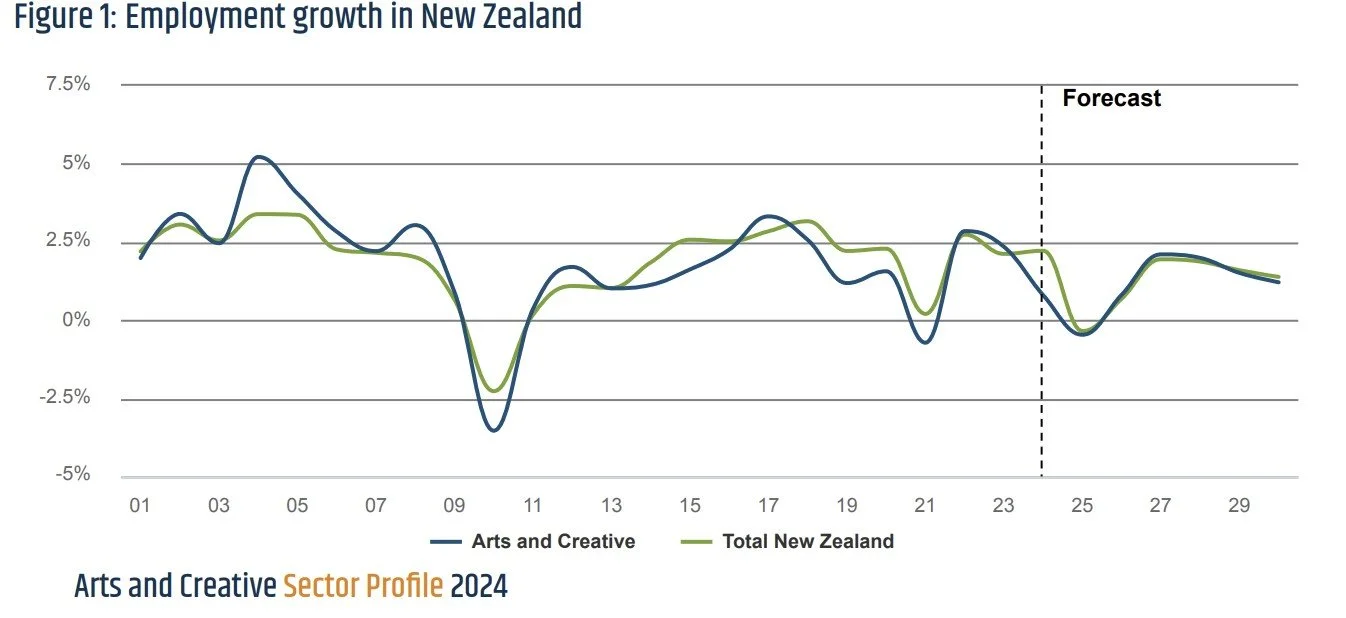
Employment growth in New Zealand of Arts and Creative vs Total New Zealand - Ministry of Culture and Heritage 2024 Report
Why is there such a massive gap between junior and senior pay?
The primary driver of the salary gap is employer risk; companies pay a premium for "proven" capability because the cost of a bad hire in New Zealand is estimated between $10,000 and $50,000.
In New Zealand, small-to-medium enterprises (SMEs) dominate the market. These business owners often lack the technical expertise to judge a portfolio effectively. To them, every candidate claims they "know Photoshop," but the employer worries that this person will take three hours to do a thirty-minute task because they can’t follow workflows.
This creates the "Experience Paradox": You cannot get the higher-paying job without experience, but you cannot get experience without the job.
The jump from the $55k band to the $75k band unfortunately isn't all about your creativity, it is about commercial viability. Employers are willing to pay significantly more for a candidate who can prove (objectively) that they understand the software enough to be proficient and efficient. They are essentially buying "risk mitigation."
Does a digital badge actually change your pay bracket?
Yes, because industry-recognized certifications act as a "proxy for commercial experience," validating technical competency to employers who lack the time or skill to test it themselves.
When an employer sees an Adobe Certified Professional badge, the conversation shifts. It is no longer about whether you can use the software; it is verified that you have passed a standardized, globally recognized exam.
This is particularly effective for:
Someone in an admin role who wants to pivot to marketing. A certification proves you are ready for the title change (and the pay bump) immediately.
If you are up against other candidates with similar experience or credentials, it can be a small point of difference, but one that tips the scales.
Someone moving from retail or hospitality into tech. The badge bypasses the "no degree" filter often used by recruiters.
Data suggests that for roles like Python development, which shares a similar trajectory to high-end technical design, certification can open doors to salaries upwards of $142,000 for experienced practitioners. While creative roles have different ceilings, the principle remains: Verified skills command higher premiums.
The Return on Investment (ROI) Calculation
We said at the start that Adobe certification was one of the best investments you can make for your career, so let’s look at the math strictly from a career investment perspective.
The cost of a typical university paper or a private college course in New Zealand can run into the thousands. In comparison, a certification, which includes training, practice tests, and the exam, typically sits between $249 and $279.
If obtaining that certification allows you to move from a "Marketing Assistant" role ($55k avg) to a "Marketing Coordinator" role ($65k avg), the immediate return is a $10,000 annual salary increase.
Investment: ~$279
Return: ~$10,000 (Year 1)
ROI: >3,000%
In an economy where every dollar counts, this is one of the few asymmetric bets a professional can make. You are risking a small amount of capital for a permanent shift in your earning baseline.
Alternatively, if you are already employed, there is a great chance your employer may even pay this cost for you.
How to get certified in New Zealand
No offence to LinkedIn Learning, but not all certificates are made equal. To build employer trust and get past the recruitment filter, you need a certificate that offers more than just a "course completion certificate" (which employers largely ignore). You want to look for supervised, internationally endorsed credentials.
Adobe partners with Certiport to deliver the Adobe Certified Professional exams globally. You can take these exams at any authorized testing center around the world, or through specific national distributors depending on your location.
The certification process is standardized globally, meaning an exam passed in Auckland has the same value as one passed in London or New York.
For Global Readers: If you are outside of New Zealand, you can find your nearest authorized testing center by using the Certiport Locator. This tool allows you to search for testing centers in your specific country or region.
For New Zealand Residents: In New Zealand, the authorized distributor for these exams is NZIQ (New Zealand Industry Qualifications). While you can book exams directly, many Kiwis choose NZIQ bundles because they are designed to mitigate the risk of failure.
Retake Voucher: NZIQ bundles include a "Retake Voucher" as a standard feature. If you do not pass on your first attempt, you can retake the exam for free within 60 days. This effectively acts as insurance for your investment.