
Portfolio vs. Certificate: Why NZ Creative Agencies Want Both
In the creative industries, the golden rule has always been simple: "Show, don't tell." For decades, a strong portfolio was the only currency that mattered. If your Behance link was fire, nobody cared if you were self-taught or had a PhD in Fine Arts.
But in 2025, the New Zealand market has shifted.
If you are a graduate trying to break into a crowded Auckland agency, or an admin-heavy professional trying to pivot into a creative role, you have likely hit a wall. You have the "eye," you have the portfolio pieces, but you aren't getting the interview.
Why? Because in a recession-sensitive economy, New Zealand employers have moved from being "Talent Seekers" to "Risk Managers." They aren't just looking for someone who can design; they are looking for someone who won't cost them money to train.
Here is why the modern creative application needs both the "Show" (Portfolio) and the "Prove" (Certification).
Is a strong portfolio enough to get hired in NZ in 2025?
Short Answer: Not always. While a portfolio demonstrates your artistic capability and style, it fails to prove your technical efficiency. In a high-churn agency environment, employers prioritize candidates who can execute commercial workflows without needing constant technical supervision.
The biggest anxiety for a Creative Director in New Zealand isn't "Can this person make something beautiful?" It is "How long will it take them?" or “Can they make this using the tools and workflows we use?”.
A portfolio shows the final destination, but it hides the journey. A stunning poster in your portfolio might have taken you 12 hours of trial and error in Photoshop. In a commercial studio, you might only have 45 minutes to resize that asset for five different social media channels.
This is where the "Self-Taught" label becomes a liability. Self-taught designers often learn result-oriented workflows, 3messy layers, destructive editing, and improper file management. Agencies don't have the budget to retrain you on the basics.
According to 2025 recruitment data, the cost of a "bad hire" in New Zealand is estimated to range between $10,000 and $50,000. For a small Kiwi studio, hiring a junior who slows down the senior team is a financial risk they simply won't take.
What are Creative Directors actually looking for?
Short Answer: Commercial Viability. According to a research paper by Edelman for Adobe: 80% of hiring managers say certifications are an indicator of a high quality candidate. Employers are looking for a blend of creative flair and rigid technical discipline. They need assurance that a candidate understands the "boring" parts of design: file structures, non-destructive editing, and print-ready outputs.
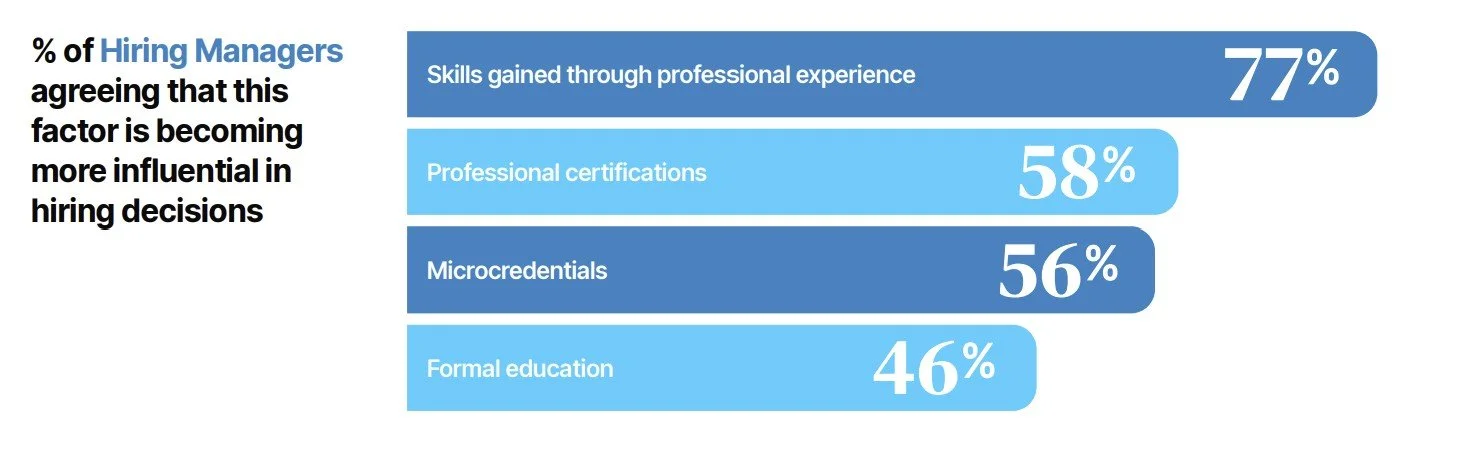
Data from the Edelman Research Paper showing Hiring Manager preference for Professional-tier certifications.
The market data paints a clear picture of what "commercial viability" is worth. There is a massive variance in pay based on proven capability.
While a Junior Graphic Designer in New Zealand starts around $45,000, salaries for experienced Seniors who have proven they can manage workflows independently skyrocket to over $93,000.
The gap between these two figures is Efficiency and Trust.
To bridge this gap, you need to prove you are an asset, not a liability. This is where the industry is seeing a rise in "Hybrid" roles, Marketing Coordinators and Digital Producers who are expected to be technically proficient in the full Adobe Creative Cloud suite.
How does technical certification validate your portfolio?
Short Answer: It acts as a proxy for experience. For candidates without a 3-year commercial work history, an industry-recognized certification proves to the employer that you adhere to global technical standards, bypassing the "lack of experience" filter.
With 57% of New Zealand businesses reporting difficulty finding skilled labor, you would think hiring would be easier. But the shortage is in skilled labor, not enthusiastic labor.
This is where the Adobe Certified Professional (ACP) credential changes the conversation.
When you attach an ACP badge to your CV or LinkedIn, you are providing objective third-party verification of your skills. It tells the employer: "I didn't just watch a YouTube tutorial. I passed a timed, 50-minute exam that tested my ability to execute specific tasks under pressure."
It solves the "Validation Crisis." It allows an employer to look at your portfolio and say, "Okay, they have the style," and then look at your certification and say, "Okay, they have the skills."
How do I build a 'Hybrid' application strategy?
Short Answer: Stack your evidence. Use your portfolio to win their heart, and your certification to satisfy their logical risk assessment. This dual approach is critical for beating Applicant Tracking Systems (ATS) and human gatekeepers.
If you are applying for roles in 2025, your strategy should be two-pronged:
The Visual Hook: Your portfolio. This shows your creativity, your voice, and your potential.
The Technical Anchor: Your certification. This anchors your application in reality.
For a hiring manager skimming through 200 applications for a "Digital Content Creator" role (a role that often pays between $65,000 and $80,000 in Auckland), the certification is a shortcut. It creates an immediate "Yes/No" filter.
Does this person know Photoshop? Yes (Verified).
Does this person know Premiere Pro? Yes (Verified).
You are effectively pre-answering their interview questions before you even walk in the room.
Getting Verified in New Zealand
For Kiwis looking to standardize their skills, NZIQ (New Zealand Industry Qualifications) serves as the local facilitator for these global credentials. While the exams are the same worldwide, ensuring your badge is recognized in London, New York, or Sydney,